
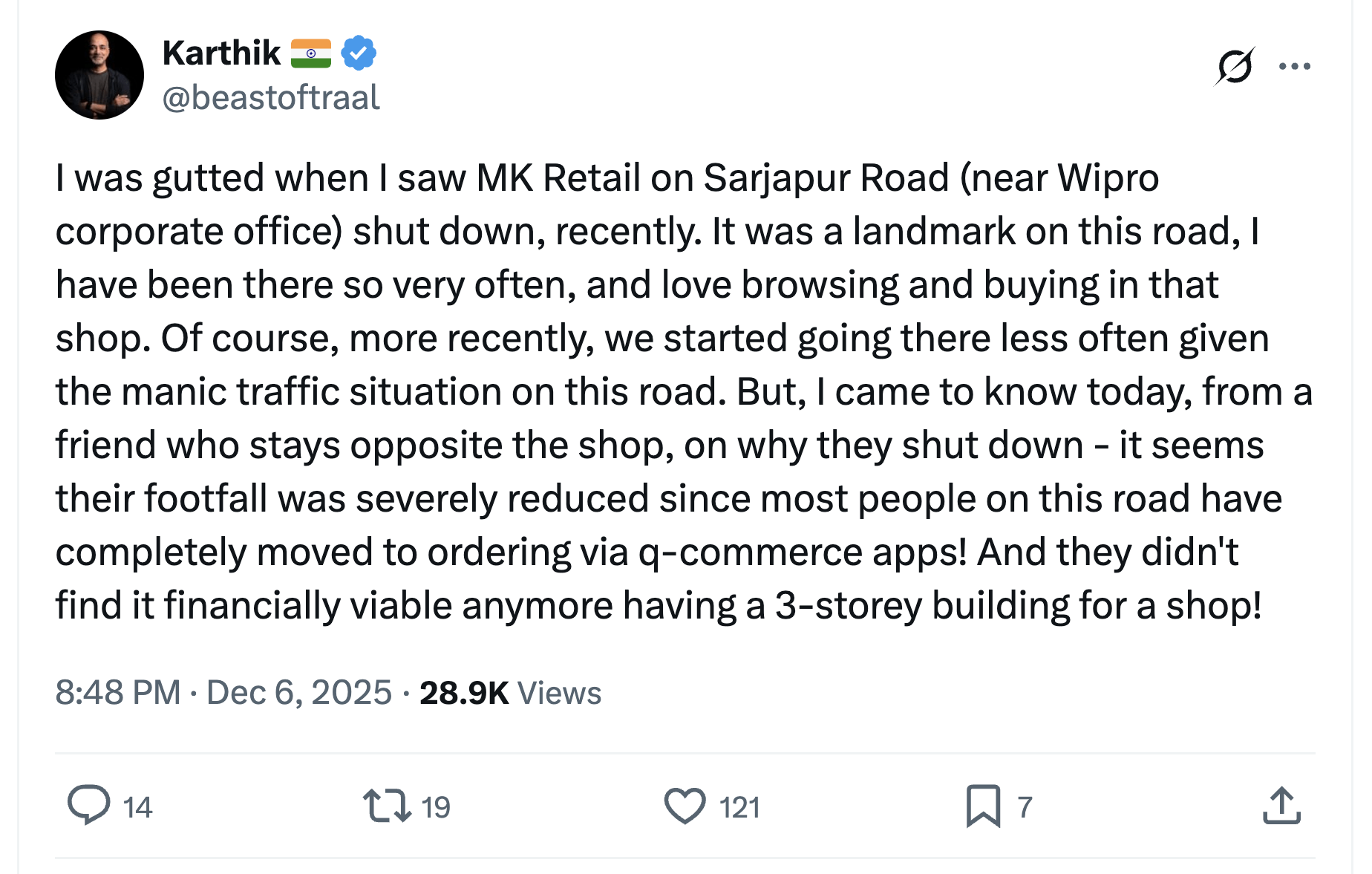
More than lamenting the end of a beloved neighborhood departmental store, I think what I am truly sad about is the death of serendipity in discovering products and brands.
In a physical store like MK Retail, brand discovery felt ambient. As I walked past shelves, I noticed new packaging and new products, compared variants, and picked up things out of curiosity. And I have shared so many such discovery pictures on social media too, most of them from this particular branch of MK Retail! Brands paid for trade schemes at the store, no doubt, but organic footfall guaranteed discovery in terms of incidental exposure.
Quick Commerce (Q-comm) aka Zepto, Blinkit, BigBasket, Instamart breaks this flow completely.
Q-comm’s interface is zero-waste. This means no idle browsing, only search, reorder, and/or order what is suggested. Discovery is not random or organic – it is algorithmic and paid. The “endless aisle” collapses into a pay-to-play feed. What this means is that if a brand is not in the top 20 results or promoted tiles, they effectively do not exist.
This implies is that brand building is now, to a large extent, decoupled from “shelf presence”.
Traditional FMCG brand building relied on 3 layers: mass media for awareness, shelf presence for consideration, and promotions for conversion. Now, the middle layer (the shelf as a physical billboard) seems to be disappearing, gradually. Q-comm replaces it with sponsored ranking, paid tiles, ‘frequently bought’ widgets, and first-party recommendation algorithms. This means brand building is no longer partially earned; it is almost fully bought.
I can hear someone pointing to the fact that D-mart stores are thriving all over India.
Sure, a neighborhood (near Carmelaram railway station) D-Mart is always crowded, but D-mart’s model is completely different. D-Mart thrives on velocity, not variety. And Q-comm is basically D-Mart’s logic wrapped in software – limited SKUs, high throughput, and assortment chosen for operational efficiency. As more offline variety-first stores (like MK Retail or Nilgiris) shut down, consumers will be (they already are) trained to expect less variety and more convenience. And long-tail brands lose free shelf visibility.
This means brand-building costs will skyrocket because brands now have to buy their way into visibility at multiple layers – paid placement, performance ads, influencer seeding, social ads, and offline activations for trust (because people see products far lesser). Ironically, Q-comm makes launching a brand easier, but scaling becomes much more expensive.
To some extent, this also extends to brand recall shifting from visual memory to semantic memory. Offline discovery is/was visual (“I remember that yellow noodles pack”). Online discovery is keyword-driven (“protein bread”, “sugar free muesli”). So, brands must now win category keywords, build semantic associations (“gut health”, “immunity”, “10g protein”, etc.), use packaging more as a thumbnail than a physical standout, and brand identity effectively shifts from packaging presence to searchability.
Long-story short: Brands losing independence! In offline retail, even a powerful retailer could only influence a brand’s fate. In Q-comm, the platform can determine who wins by controlling visibility, search results, recommendations, and category expansion. We may be moving into a world where brand-building (and hence, brand success) is platform-mediated, not consumer-led. In other words, brands don’t win the market, but platforms choose who gets a chance to win.
The new FMCG brand-building stack looks very different, now, as a result. Winning brands will excel at:
- Cultural brand-building – because the shelf no longer builds awareness, culture-level brand building must generate social buzz, video moments, register memetic hooks. Add founder-led storytelling to the mix, across social platforms like X, Instagram and LinkedIn.
- Algorithmic optimization – paid visibility + high throughput + good unit economics.
- Community-led trust – reviews, user-generated content, influencer validation… all geared to replacing the ‘touch and feel’ reassurance of offline.
- Multi-platform presence – brands must exist on: Zepto, Blinkit, Swiggy Instamart, Amazon, Big Basket, Nykaa (where relevant, for the category) + others, to ensure that the consumer sees them repeatedly. One-platform brands may find it very difficult to survive.