
Back in the days when I was a ‘client’ (a corporate communications professional in an organization, for the uninitiated), the day after a big announcement (every announcement was big, to any client) was very important. It would be spent in frenzied scanning of all the newspapers to see where we have been ‘mentioned’.
Despite having our mention in say, 8 out of 10 newspapers, my boss used to occasionally ‘tsk, tsk’ me with, “I got a call from a friend who reads XYZ newspaper and he was wondering why our announcement was not mentioned in that newspaper. Is the ‘coverage’ not good enough?”
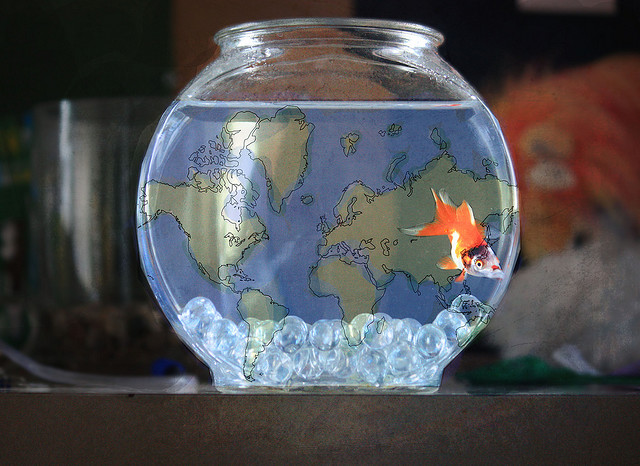 Why this introduction?
Because we seem to be preoccupied and enamored by our own little sources of information – so much that only they seem to make our little worlds!
In the internet age/social space, this problem (yes, it is a problem) is accentuated.
The other day, I heard a friend ask me, “Hey, have you seen those tweets about that new announcement…everybody’s talking about it!!”
I searched for that announcement on Twitter and found exactly 2 relevant tweets in 24 hours. So, I called him and asked him to explain the ‘everybody is talking about it’ part. He said he saw a tweet from a friend and assumed that the news is spreading.
It is interesting because our perception about something seems to be limited only by our curiosity to go deeper into a topic. If we don’t go deeper (or choose not to), we base our assumptions on the limited information available to us. But if we go deeper, we get close to the actual situation (the truth?).
Internet and social tools provide us with a lot of tools to go deeper into anything – any subject or piece of news – and that too, with no major time investment. Take for example, random amazing facts that we sometimes encounter on Facebook or Twitter. If only we spent a few seconds doing a Google about that ‘fact’, we may perhaps stumble on a page in urbanlegends.com about that astounding fact. We could even corroborate it by seeing many other pages referring to that fact as a myth.
But, very few people go that extra length in ascertaining the truth using online tools – it is definitely not a question of time since it barely takes a few seconds. It is more about our ability to question things and get to the bottom of things…and not live on assumptions.
So, the next time you read about a piece of news about something that seems amazing, try questioning both sides of the story – (1) yes, it is indeed amazing and (2) What hogwash!. Use search to find the truth about both those sides – then, you’d know if that news is really as amazing as they make it out to be or if it is just a PR spin. PR is about creating perceptions and these days, with the help of the internet, most spin’ish stories can be exposed as a…well, spin. So, the closer a PR effort is to the truth and the more proof-points it has, the better, for the story and for all the people involved in the story.
Consequently, it is quite easy to use this trait of ours for PR purposes! Someone wrote to me via LinkedIn the other day that he noticed someone (he knows) joining a company and that (by that logic alone!), this company may be doing very well since they are hiring. I spoke to someone in that organization (which had hired) and found that they have a freeze on hiring and the new person was merely a replacement hire! You see how we extrapolate our limited exposure to things into something much larger?
To bring back my client-side stint, the day my boss told me about his friend not finding our news in the newspaper he was reading and the assumption that the ‘coverage’ did not seem good enough, all I had to do was to show him the 8 newspapers (out of 10, mind you!) where we were ‘covered’! This told him in no uncertain terms that it was not our effort that was lacking…it was rather his friend who was reading that one odd newspaper where our news was not featured!
Photo by -Fearless- via Flickr.