
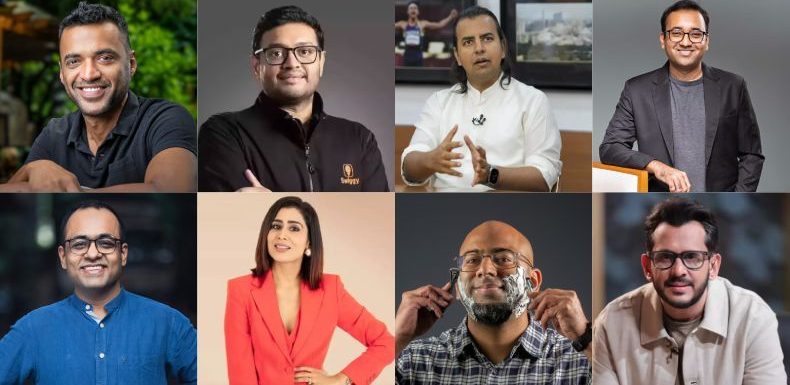
A quick summary:
Visibility is an advantage, not an obligation: High-profile founders (Zomato) and reclusive ones (Swiggy) can both build enduring, market-leading brands – execution and reliability matter just as much as fame.
Additive vs. Expansive branding: Founder visibility succeeds when commentary constantly routes back to the core category (additive); it risks brand equity when it drifts into unrelated hot takes or general creator content (expansive).
Tone dictates trajectory: The distinction between vocal founders isn’t volume, but accountability versus combativeness – as shown by the contrasting market perceptions of Ather and Ola.
The long-term test is still underway: Internet-native founder branding in India is barely a decade old; today’s most-cited D2C success stories are only halfway through proving long-term brand durability.
The ultimate test is decoupling: A founder-led brand matures through a 4-stage lifecycle; true success means the company’s brand equity continues to compound even if the founder steps back or goes silent.
10 years ago, selling a consumer product in India meant hiring a celebrity. Today it increasingly means putting the founder in front of the camera instead, and, as advertising veteran Sandeep Goyal argued in a recent Business Standard column, for good reason. His diagnosis is worth starting from: India is a high-context, relatively low-trust market, so people buy into people before they buy into logos and brand names. A face is accountable in a way an anonymous entity isn’t.
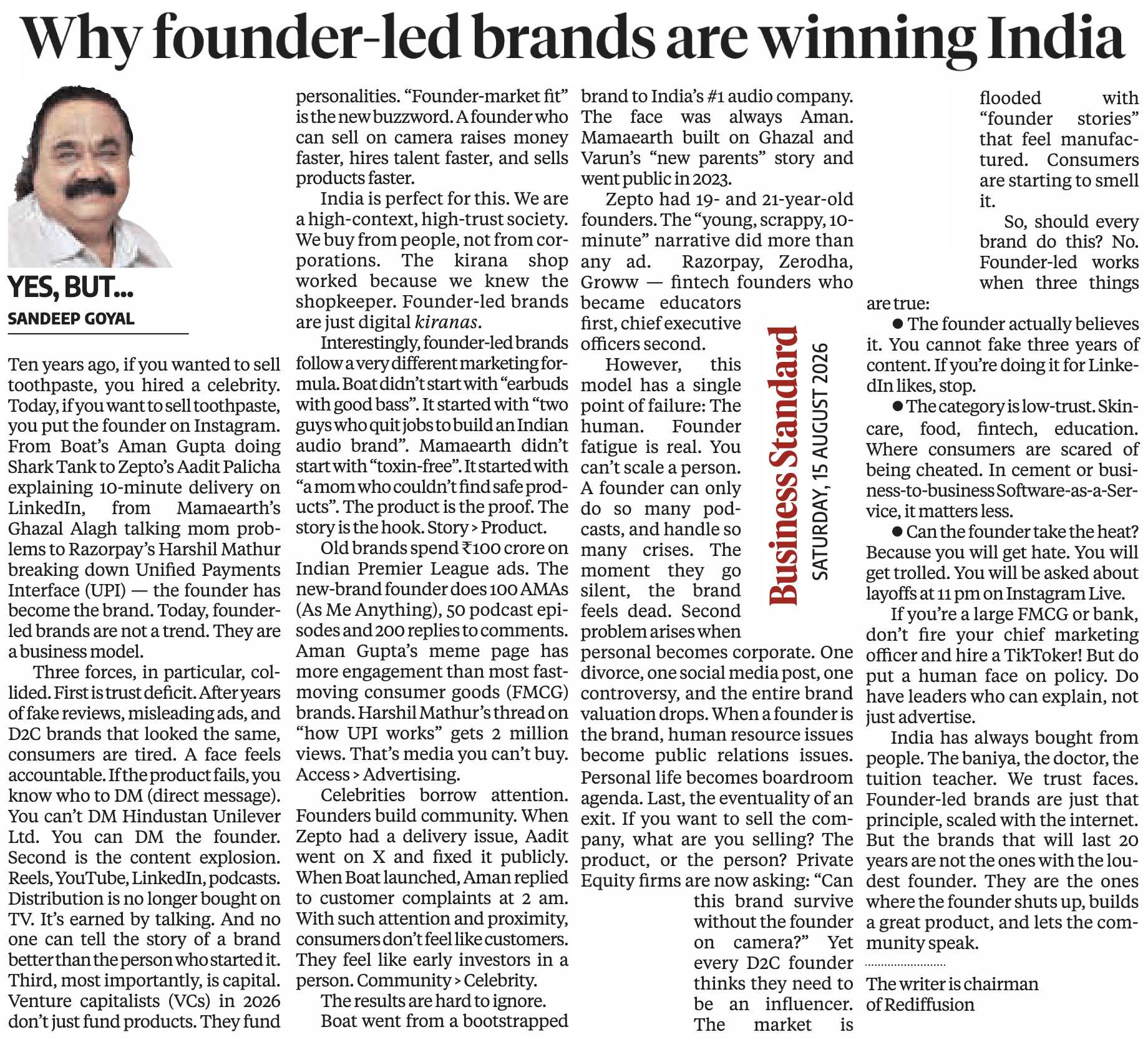
Sandeep traces that shift to two other forces beyond trust. One is the content explosion (via Reels, LinkedIn posts, podcasts, YouTube videos, etc.) which means distribution is no longer bought on television, but earned by talking, and no one can tell a company’s story better than the person who started it. The other is capital: venture investors, in his framing, don’t just fund products anymore, they fund personalities, because “founder-market fit” has become as important to a raise as the business model itself. A founder who can sell on camera raises money faster, hires talent faster, and moves product faster.
Sandeep’s examples for this are hard to argue with. Boat went from a bootstrapped brand to India’s top audio company with Aman Gupta as its inescapable face. Mamaearth was built on its founders’ “new parents” story. Fintech founders at Razorpay, Zerodha, and Groww became educators first and executives second, and their threads on how UPI actually works routinely outperform anything an ad budget could buy. There are a lot more examples beyond Sandeep’s article too. Shashank Mehta and The Whole Truth. Revant Himatsingka and Only What’s Needed. Namita Thapar and Arth/Emcure.
Access, as Sandeep puts it, has beaten advertising. Community has beaten celebrity. Story has, in many cases, beaten product.
But there’s a genuine problem sitting below this success story, and Sandeep doesn’t smooth over it either: the same founder visibility that builds a brand can also become its single point of failure. His phrase for it is that you can’t scale a person – a founder can only do so many podcasts, handle so many crises, survive so many controversies before the personal starts contaminating the corporate. One bad divorce, one ill-judged post, one prolonged silence, and the brand can feel like it’s gone quiet with them. When a founder is the brand, HR issues become PR issues, and personal life becomes boardroom agenda.
This is precisely the fork Sandeep’s column arrives at. Having spent most of its length building an enthusiastic case for the vocal founder, it closes on an almost opposite note, with his argument being that the brands built to last two decades won’t be the ones with the loudest founder, but the ones where the founder eventually steps back, lets the product speak, and lets the community carry the story forward. Read on its own, that reads like a contradiction: the same piece that spent 800 words proving visibility wins ends by implying silence is what actually lasts.
It is not really a contradiction, though!
It is two different claims wearing one costume, and pulling them apart is where my post here wants to pick up from where Sandeep leaves off.
The question is never about “should founders be loud or quiet?”. My point is around, ‘what kind of loud, and what kind of quiet, actually determines whether a brand outlives its founder’s need to perform?’.
Founder-led is not one thing
Before getting to examples, it’s worth separating three things a founder can do with a public presence, because from the outside they look identical (because all involve similar tools, like posting, podcasts, interviews) but strategically they are not the same at all:
- Being the face of the company. Visibility, full stop.
- Building a personal brand that adds value to the company’s brand. Personal branding, properly defined, understood, and executed.
- Becoming a content creator who happens to own a company. Essentially a media business.
The third is where things get dangerous, because a founder can become genuinely excellent at generating attention for themselves to the point where that attention stops transferring to the brand. That’s the real paradox of founder-led branding: the founder can become the company’s greatest distribution asset, and its greatest dependency, at the same time. Which mode a founder is operating in (and not how loud they are) is the variable that actually predicts what happens over 20 years. India’s startup landscape already has two live, long-running experiments that make this concrete.
Zomato vs Swiggy: a near-controlled experiment, and both sides win
Deepinder Goyal has spent close to two decades as one of Indian startup’s most recognizable faces. He has a point of view on food culture, logistics economics, city-level consumption patterns, among others… a presence inseparable from the Zomato (now Eternal) story. Crucially, that presence has stayed additive: even when a post doesn’t mention the company, it’s structurally about the world Zomato operates in. You rarely have to ask why the Zomato founder is talking about something – the answer is usually implicit.
Sriharsha Majety and Nandan Reddy, who built Swiggy into the co-leader of the same category, are close to the opposite case. Sriharsha in particular has been openly described as reclusive, in explicit contrast to Deepinder’s habitual visibility. Sriharsha himself has said, in one of the few interviews he’s given, that he never built Swiggy to make himself a public figure, and that he doesn’t worry about his own status the way some founders do. No large personal following, no recurring commentary – just the product and operations do the talking.
By the numbers this is close to a controlled experiment. Foodiebay/Zomato was founded in July 2008; Swiggy in December 2013. One has/had a vocal founder, one with near-invisible founding team, competing in the same category, for well over a decade. Both ended up leading it: Zomato/Eternal holds roughly 55–58% of food-delivery gross order value against Swiggy’s 42–45%, and both are now listed, profitable-or-nearly-so, and dominant. Swiggy is founder-built, not founder-dependent, and it still won.
There’s a wrinkle that sharpens this rather than complicating it. In February 2026, Deepinder Goyal stepped down as MD and CEO of Eternal, handing the top job to Blinkit’s Albinder Dhindsa and moving to the board as vice chairman, citing a pull toward “higher-risk exploration” better pursued outside a listed company. The company he built his personal brand alongside for eighteen years is now run day-to-day by someone else. It’s close to the ideal case study for the very tension the Business Standard column gestured at: the vocal founder built the brand, then, by choice, not scandal, stepped back, and the brand did not blink.
Neither posture is “more correct”, however. Zomato/Eternal’s moat leans on attention and cultural relevance; Swiggy’s leans on pure execution and reliability. Different assets, not different quality tiers. Which raises the sharper question that gets skipped when the debate is framed as loud-versus-quiet: what does founder visibility actually do for a brand that product, community, and marketing can’t do on their own? If the answer is “a lot”, then such visibility is worth building. If it’s “not much”, there’s no reason to manufacture a personality that isn’t already there.
Ola vs Ather: same “vocal” label, opposite outcomes
If Zomato-Swiggy shows vocal and silent can both win, Ola-Ather shows something different: not all vocal is the same vocal.
Bhavish Aggarwal is relentlessly online (somewhat muted only recently) and by most measures more visible than almost any Indian founder. But a meaningful share of that visibility has come from combative, not accountable, moments: publicly demanding an apology from an unnamed auto journalist over leaked pre-launch images and threatening to cut off media access altogether; a widely covered public spat with comedian Kunal Kamra over customer complaints about scooters piling up unserviced at dealerships; a “western illness” remark on gender pronouns that drew sustained backlash, and his repeated (first, second) trolling of auto journalist Hormazd Sorabjee. The volume is high. The tone is frequently negative, and once a founder is this fused with the brand, the two identities stop being separable. What Bhavish says, Ola is understood to have said.
Tarun Mehta at Ather has taken close to the opposite approach – not silent, but selective, speaking mostly through structured moments (launches, funding milestones, EV policy positions) rather than unscripted combat, and staying close to the category when he does. The commercial gap has widened accordingly. As of July 2026, Ather held the No. 3 spot in India’s electric two-wheeler market with roughly 14.9% share; Ola Electric had slipped to fifth place, at around 6.9%, down from double digits just months earlier.
None of this proves Ather’s quieter founder caused its rise, any more than Ola’s vocal founder single-handedly caused its decline… product, service record, and dealer network matter enormously. But it does demonstrate that founder visibility is neither a substitute for product nor a guarantee of reputation. When visibility turns abrasive, the founder’s personality starts contaminating the brand’s personality. The variable that matters isn’t loud-versus-quiet. Rather, it is what the loudness is spent on, and whether it’s building trust in the founder or spending down a reserve of goodwill on fights that have nothing to do with the product.
The 20-year math needs a historical reset
The Business Standard column’s closing framing (brands that last 20 years) deserves to be taken literally, because the number implies a starting point, and the starting point matters more than a casual read allows for.
20 years back from 2026 is 2006. It was the year Twitter launched, and the year Facebook opened registration beyond its original campus restrictions. The iPhone didn’t exist until 2007. None of that translated into founder-led personal branding as a real business-building mechanism in India at the time: smartphone adoption was in its infancy, data was expensive, and the creator economy didn’t exist in anything like its current form. The real acceleration came later, through the late 2000s and early 2010s as social platforms matured, and then decisively from September 2016, when Reliance Jio’s free-data rollout reset the economics of internet consumption in India altogether.
In other words: for most of the last 20 years, there was no infrastructure for a founder to self-build a personal brand independent of mainstream media and traditional PR. Founder-led brand, in the internet-native sense that’s usually meant (Reels, LinkedIn posts, X spats, podcast circuits) has really only been possible in India for about a decade or lesser, not twenty years. Which means the honest 20-year test can’t be applied to 2006-era brands. It has to be applied to companies founded around the mid-2010s, judged against 2036, not 2026, and by that standard, today’s most-cited proof points (Boat, Zepto, Mamaearth) are only roughly halfway through the test.
Which is exactly what makes Zomato and Swiggy useful again, not as social-media-era founder brands, but as the closest thing India has to a completed longitudinal run, spanning the pre-social and social eras both. 18 years for Zomato, 12 for Swiggy. That one vocal founder and one near-invisible founding team both cleared 18 and 12 years in the same category, and both built category-defining businesses, should make anyone suspicious of a universal rule that founders must become media personalities. Founder visibility is an available strategic advantage, not a strategic obligation!
Additive branding vs expansive branding
Here’s the distinction that explains why some vocal founders compound goodwill and others burn it, and it has nothing to do with how often they post.
Additive personal branding is when everything a founder says, however wide-ranging it sounds, ultimately routes back to and reinforces the category and the company. Deepinder Goyal talking about Indian food culture, logistics, or Blinkit’s operating model is, structurally, always about Zomato/Eternal, even unbranded. It adds to the reservoir and rarely spends it down, because the founder rarely wanders outside the zone where the brand has a stake.
Expansive personal branding is the opposite move: the founder treats the platform as a general-purpose soapbox, where the company is present but a minority share of the total output. Shantanu Deshpande at Bombay Shaving Company is a useful example, and a genuinely clever one, because much of his expansiveness is deliberate strategy rather than drift. His YouTube podcast, The BarberShop with Shantanu, was explicitly conceived as a marketing vehicle, built around founder-led, unfiltered content rather than slick advertising, on the theory that hearing from him adds more to the brand than any ad could. But his LinkedIn presence also regularly wanders into commentary well outside grooming, like entrepreneurship, work culture, ambition, and the wider life of a founder, and some of which (his widely discussed “grind culture” post, for one) has travelled far beyond BSC’s category.
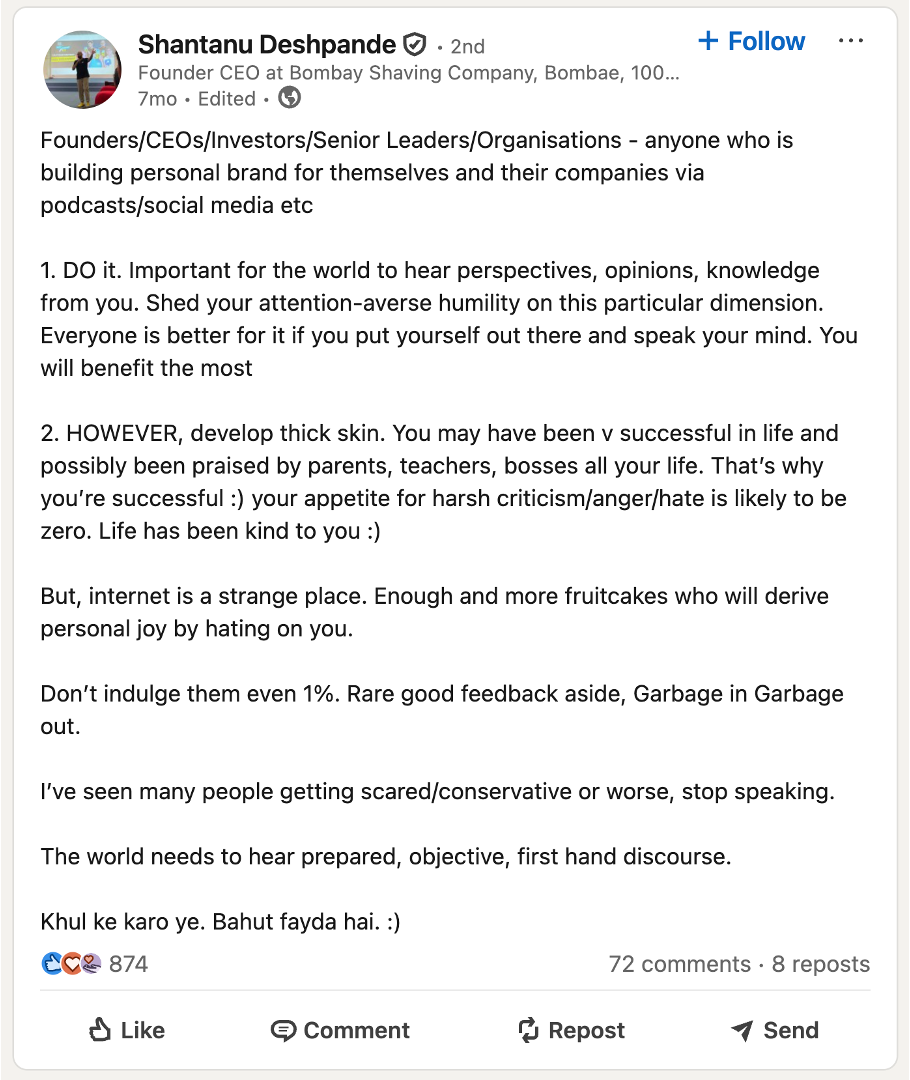
That’s not automatically wrong. Expansive commentary can build a bigger personal following faster than additive commentary ever will. But it carries more surface area for controversy, because the founder is now personally answerable for opinions that have nothing to do with the product they’re accountable for building.
Additive branding is lower-risk and slower-compounding.
Expansive branding is higher-risk and can spike faster, in either direction.
Example:
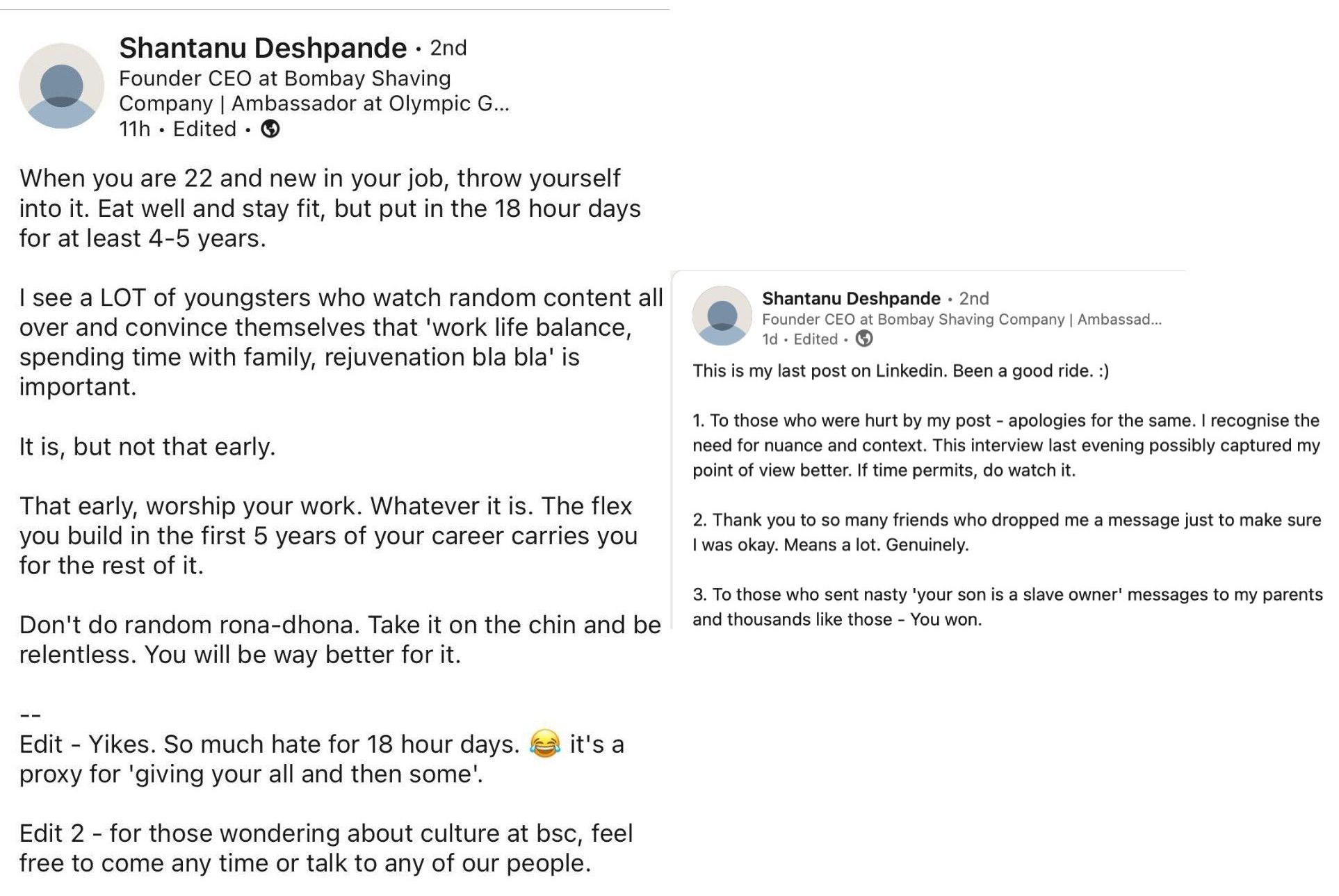
PS: Of course, that wasn’t Shantanu’s last post at all 🙂
At what point does a founder stop being a brand ambassador and start becoming a creator? Once that shift happens, the incentive structure changes: a creator optimizes for attention, a founder should optimize for the company, and the two overlap but are not identical.
The founder-as-content-creator trap
This is the sharpest failure mode, and it isn’t about volume at all. It’s founders who stop building a personal brand in service of the company and start behaving like content creators who happen to run a company.
Shark Tank India has accelerated this pattern visibly: a founder appears on television, becomes meme’able, starts getting podcast invitations, accumulates a following, and discovers that personal visibility is itself an asset, distinct from the company’s. Soon they’re being asked about leadership, money, careers, productivity, India, AI, life, and it all becomes a virtuous-or-vicious circle of attention leading to more invitations leading to more attention, in which the company becomes almost incidental to the personality.
Zoho’s Sridhar Vembu is a useful, different-flavored example of the same underlying question.
His public commentary (on rural employment, education, India’s development model, indigenous technology, and of course, Indian politics) genuinely extends well beyond Zoho, and it’s intellectually substantive rather than opportunistic (though one can argue that his political perspectives do support the ruling regime, and hence is/can seem opportunistic). But it raises the same test: if Sridhar writes about ruling party policies, does that strengthen Zoho, specifically? Possibly, if there’s a connecting link. Does a large independent audience built around his general worldview belong to Zoho, or to Sridhar personally? The honest answer is usually “both, partially”, and it’s rarely 100% transferable back to the business.
None of this means these founders are wrong to have wide, vocal interests, or that their audiences don’t value the range – plenty of it is genuinely valuable public commentary, depending on how much you like them, of course. It means the founder’s personal brand and the company’s brand have partially decoupled: the follower is there for the person’s opinions, not necessarily as a signal of trust in the product or the company. That’s a legitimate creator strategy. It’s just a different game from the one “founder-led brand” is supposed to describe, and conflating the two is where the phrase starts to lose its usefulness.
A lifecycle, not a contradiction
Seen this way, the apparent contradiction that closed the Business Standard column isn’t really a contradiction. It may be describing a lifecycle that most founder-led brands pass through, whether or not the founder plans it that way:
Stage 1 — the founder supplies trust. Nobody knows the company; the founder explains why it exists.
Stage 2 — the founder supplies distribution. The founder’s audience lowers the cost of getting attention.
Stage 3 — the founder supplies meaning. The founder’s personality becomes part of what the brand stands for.
Stage 4 — the brand supplies its own meaning. Customers, employees, and communities tell the story without needing the founder to.
That 4th stage is the real test, and it’s also close to a diagnostic test any founder can run on themselves: If you stopped posting tomorrow, what would happen to your brand?
“Our reach would fall, but the brand would carry on” is healthy.
“Our engagement would collapse and nobody would know what we’re doing” is a warning.
And “actually, my personal following is bigger than the company’s” is a different warning altogether… evidence that what’s been built isn’t founder branding, but a separate media business with a product company attached to it.
What actually predicts durability
Remove all the false binary, and four variables do the work, in my opinion, and they map closely onto the diagnostic I already extensively use in my personal branding workshops: depth of category expertise, range of relevant topics, and the distinctive color a founder/person brings to how they say it, all filtered through whether what’s said can survive scrutiny.
- Topic discipline: does the founder’s visibility route back to the category (additive), or has it drifted into general commentary (expansive, or full creator mode)?
- Tone under pressure: when the founder speaks on something sensitive, does it read as accountable, or as combative and defensive?
- Decoupling readiness: has the company built enough product and operational credibility to survive the founder going quiet, changing role, or leaving — the way Eternal has just had to prove, in real time, with Deepinder Goyal’s own move to the boardroom?
- Selectivity: is visibility deployed at moments that matter, or is it constant noise regardless of relevance? Deepinder is especially very effective here. His personal responses have mattered a lot in how Zomato has weathered some crisis situations, wrought by their own rash ideas in marketing and operations. There’s a big difference to a logo explaining a blunder and apologizing for it, and a founder doing it, as part of their ongoing online content.
Zomato and Swiggy both pass on these terms, despite opposite founder postures. Ather passes and Ola largely fails, despite both founders being unmistakably “vocal”, in very different ways. That’s a much better lens than loud-versus-quiet, and it points to a better question than the one the founder-led-brands debate usually asks: Can the founder become famous? Vs. Can the founder’s fame compound into the brand, and can the founder eventually become less important without the brand becoming less valuable?
A founder can be the company’s most powerful distribution asset without being its only distribution asset.
A founder can be the most recognizable face of a brand without making the brand inseparable from their personality.
A founder can build a large personal following without turning the company into a subsidiary of their personal media presence.
The best founder-led brands will therefore not necessarily have the loudest founders, nor the quietest ones. They will have founders who understand why they are speaking, what territory they have earned the right to speak about, and how their visibility can add equity to the company rather than merely equity to themselves.