
 A website called Traackr recently published a Top 25 in PR 2.0 influencer list. Such lists are common nowadays; cook some algorithms to crawl through online content created by people, using keywords, and voila, you have a list. What was interesting and contested was the inclusion of a well known HR influencer, Gautam Ghosh, at No. 19 (as of writing this post, No. 25).
The list does not include other obvious PR 2.0 stars online, like Steve Rubel, David Armano, Dave Fleet, Michael Brito or even Brian Solis (at least when I saw it while writing this – given it is a dynamic list, their names might pop-up eventually; but…not having their names in the first version is strange!). So, I really wonder what arbitrary metrics Traackr uses to cook such lists, though they do make a scientific-looking argument to explain that process…which goes for a toss when you see the list, its glaring omissions and that one odd addition (Gautam Ghosh).
Traackr’s caption is ‘measuring online influence’. I have already written enough about this online influence business (See: The holy grail of online influence vs. our current measurement limitations; A different perspective on online influence mining; Influenced enough to attempt explaining influence), so let me try to add 3 specific, new angles to it without regurgitating facts.
1. How was influence identified and mined before social media happened?
One of the most important sectors that held sway over influencer relations was the public relations business. Advertising made use of the influence business too, but it looked more to buy influence and make an attractive package out of the deal. Example? Celebrity endorsements.
Public relations, on the other hand, looked at context and hoped to convince influencers to see the perspective of a client, either on a product or a service. Before social media happened, influencers were predominantly in 2 large buckets – media-related influencers and professionals.
Media-related influencers were and are the mainstay for the PR business. It was, in simple terms, looking at the most read/viewed broadcast media, engage with the right journalist/reporter in such media vehicles and get exposure for the appropriate client – all in the hope that the well-received media will reach as many relevant target segments as possible and will eventually change something inside them!
Professionals were those who were known/popular for some kind of an achievement (entertainment, sports etc.) and who seemed to be in the news for the right reasons.
But – and here’s the real deal – these were influencers who depended on a platform that was owned by someone else. A journalist rides on a publication’s influence that has a life of its own. A successful sportsman used(s) a mainstream media vehicle to amplify his views. The platform was responsible on its own, to publicize and make it popular and in turn used the voices available within it to promote them and itself.
Most importantly, what did these influencers offer/promise? Did they offer a change in perception? Did they enable sales? Did they have some effect on their audience? Yes, of course, all of the those, but a lot depended on the credibility they had built, at a personal level and the reach of the media/platform they used to communicate. Also, since the media used were predominantly offline, there were only rudimentary ways to correlate or explain influence. It was more of a perception, than any consistent method.
2. What is different about social media/online influence?
To start with, I’d assume that an online influencer owns the media/platform he communicates through. It could be a blog, a twitter handle, a LinkedIn profile, a Facebook page, a Quora account…and may be all those combined too. Some of them, while having powerful owned channels, also make use of existing media (like a guestblog by a well known blogger in the online version of a magazine) to increase their reach.
Given the nature of online media and how it enables basic metrics to be tracked far more easily, some of the more obvious metrics used includes number of fans, followers, RSS subscribers, page views etc. This is nothing but the online equivalent of, say, a magazine’s readership numbers. It only means how many people it reaches and not how many people trust it to make decisions or even assimilate the many pieces of content made available in it.
Of course, online tools help us go a bit deeper – a particular blog post, about a topic, could help us understand the kind of people who are interested in it. By using comments, sharing patterns or ‘like’ patterns, one can extrapolate that a piece of content on a given topic is popular, and it’s owner, an influencer.
So, now we’re coming closer to an online influencer. He seems to be someone who is seen as a credible and knowledgeable voice on a particular topic(s), based on his past behavior vis-Ã -vis that subject/topic. Now, that sounds exactly like how I had defined an influencer in the previous point, except for the obvious difference on who owned the media/platform.
3. What is expected out of an influencer – online or offline?
In simple terms, the power to seed a thought and perhaps, make a change in thought. Brands want this power to enable sales, at the most basic level. At a higher level, brands want this power to make a change in perception for the causes/businesses they are associated with.
In one of my earlier posts, I had referred to a myopic experiment to explain influence. If only they had applied context in that experiment, they could have ended up with some solid results! That…brings us to context, in influence.
It is amazing to see how far from reality we have moved – from looking at a good combination of numbers and context (in PR, for instance, we look at the reach of a publication and look for a journalist in a space relevant to a client – that combination), to only looking at numbers! Or, like in Traackr’s case, looking at numbers plus keyword match-dependent context. So, its no wonder seeing an HR influencer make it to a PR 2.0 list by nature of him having spoken about PR and influence, albeit only fleetingly.
Anybody who has interacted with Gautam, or seen the last 10 of his blog posts or read the last 50 of his tweets would easily notice a strong HR focus. But that’s the whole point – these lists want to automate and scale influencer identification and that scaling process cannot afford human intelligence intervention, at least as of now.
And, there are things that an influencer could be a consumer of – he’s human too and some of the basic needs are similar across all. A movie may be of a HR influencer’s interest too, so it may be worthwhile to pitch to a HR influencer about a new film knowing fully well that it satisfies only one of the 2 conditions of reach + context…reach. Context is only very, very vague, if you go by what that person is influential/credible for.
So, if we extrapolate this engagement to an online call-to-action (unlike a film)…a book purchase online, a click on an URL, a ‘share’ or a ‘like’ etc., it becomes easier to connect the impact with an influencer. Remember…this direct correlation was not that easy in the pre-social media days.
—
Interestingly, this harks back to my earlier post from last week, about the lack of a PR media list equivalent in social media influencer engagement…meaning, there is no shortcut. Lists like the one made by Traackr assume that they can enable a shortcut, but they end up being woefully inadequate or adequately contested. They could come in handy to the lazy PR pro + lazy client combination, but they may not stay client-agency for a long time if they continue to rely on such automated lists. All they enable is a starting point, for you to add the much-needed human intelligence layer, in the interest of your profession and in the interest of your client.
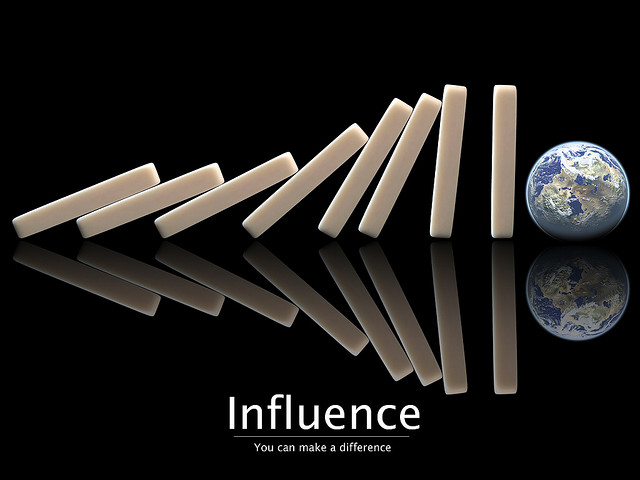
Pic courtesy Badger.20 via Flickr.