
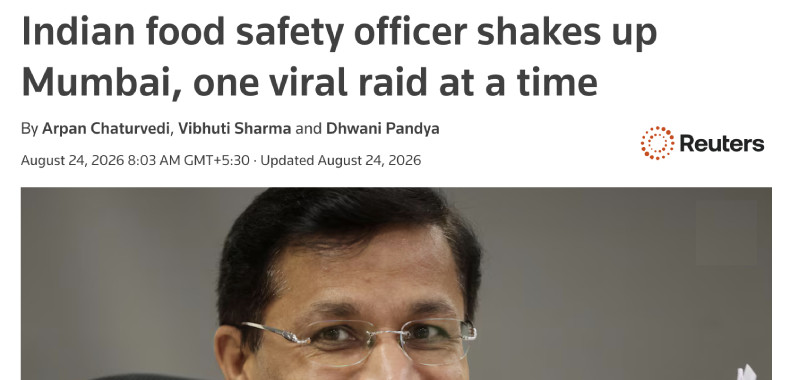
Tukaram Mundhe has been transferred 25 times in 21 years.
His admirers cite this as proof of his integrity. A bureaucrat too honest to let entrenched interests keep him anywhere comfortable. Fair enough. But there is another other implication left unsaid too – this is a man whose institutional tenure has never once lasted. Every posting he’s made history in, he’s eventually left (forced to leave, to be fair). So, by his own track record, Maharashtra’s food safety crackdown has an expiry date, and nobody knows when it is, including him.
Honestly, Tukaram Mundhe’s food-safety crackdown is welcome. In fact, it is long overdue. But it has been framed as a personality story rather than an institutional one.
The enforcement itself is not uniquely effective in Maharashtra. It’s uniquely visible.
And to be sure, the visibility isn’t entirely accidental.
When Mundhe took charge, the Maharashtra FDA’s previously quiet media machinery changed almost immediately. The Indian Express reported that the department’s near-silent media group suddenly began receiving a steady stream of press notes, photographs and videos documenting raids.
Mundhe himself has acknowledged the change. When asked why such action wasn’t visible before his arrival, he said that while enforcement had happened earlier, “the other factor that is different from earlier is that we are making it public as well”. He has been explicit about the rationale – people should know what they are eating, where they are eating and whether those establishments comply.
There is nothing wrong with this strategy at all. In fact, food-safety enforcement probably needs more public communication, not less. If photographs of filthy kitchens make consumers more demanding, and publicity makes businesses more compliant, that is absolutely a public good. The distinction, however, is between putting the offence in the spotlight and putting the officer in the spotlight. Somewhere along all the visibility, awareness and adulation, Maharashtra’s FDA campaign acquired a protagonist… a hero of sorts, and the protagonist acquired a brand.
You could argue that this may just the media’s fault that Mundhe became famous, not the man himself. Partly true. However, the communication strategy was deliberately intensified, for perfectly legitimate regulatory reasons. But once you make publicity central to enforcement, you have to think carefully about whether you’re building public trust in the institution or personal trust in the person.
A leader can use personal visibility to make an institution visible. The danger is when, eventually, the institution becomes visible only through the leader.
And this is where the examples from other states become important.
Karnataka’s FDA inspected 60 3-star and 5-star hotels in a single 3-day drive in August, seizing 1,089 kg of unsafe, expired or mislabelled food and other products.
It didn’t stop at private hospitality either. The same enforcement drive reached Vidhana Soudha, Vikasa Soudha, Legislators’ Home and the Health Department headquarters and even the Health Department’s own Arogya Soudha canteen was found with expired food and hygiene violations.
In June alone, the department covered 720 hotels and restaurants statewide, 871 food stalls, 600 anganwadi centers.
No commissioner’s name attached. No standing ovations and no viral clips either. Just a department running its process, unwilling to carve out an exception even for its own government’s address.
Delhi has run its version in parallel. FSSAI’s recent inspections of Andaz Delhi and JW Marriott in Aerocity found serious food-safety, hygiene, storage and licensing violations, including cockroaches, mouldy/rotten produce and inadequate pest control.
No commissioner became the story. The institution simply did the work.
In fact, And perhaps that is the less exciting story we actually need more of, across the country.
There’s just not enough enforcement when it comes to food safety in India. That is why it feels so welcome when we read these reports from Bengaluru, Delhi or Mumbai. It is also why they instill a certain fear when we discover that famous hotels and the dark stores of quick-commerce companies we buy from every day can have such poor hygiene and food-storage practices.
That fear is not necessarily a bad thing. We question more, analyze more, demand more… and overall awareness levels go up.
Of course, Maharashtra did produce the bigger headline – 3,137 establishments inspected between May 25 and July 31, 165 licences suspended and Rs. 55.72 crore worth of unsafe food seized or destroyed.
The news from last week was also that the Bombay High Court came down heavily on FDA officers in Maharashtra, asking them, “Do you think you (FDA) are a Lord …you can do anything?“. Why? For skipping due process in the name of speed and visibility!
So, this is not merely a theoretical concern about personality-driven enforcement. The Bombay High Court has flagged precisely the sort of institutional safeguards that can get lost when speed becomes the overriding virtue. In the case of five restaurants at the Mumbai Cricket Association’s BKC premises, the court found that the FDA had responded to an earlier direction to reconsider the matter with what it described as a “mechanical” and “pedantic” order, rather than applying its mind and taking the “pragmatic” approach the court had asked for.
The judges questioned why the department was acting in such “undue haste”, stressed that regulatory orders must give reasons, and warned of contempt proceedings when the FDA appeared not to follow the court’s directions. In the separate Cipla matter, the FDA had scheduled a personal hearing on a state government-declared public holiday, rejected an adjournment request and proceeded with licence cancellation! The High Court held that the procedure had to respect natural justice and ordered the process to be restarted. The point is definitely not that the FDA should be soft. Instead, it is that strong enforcement is not the same thing as instant enforcement. A regulator’s legitimacy comes not merely from having the power to act, but from exercising that power through a process that is predictable, reasoned and capable of surviving judicial scrutiny.
And this is where the communications story becomes an institutional one.
Karnataka’s 720-hotel sweep (including its own legislature’s kitchen) barely made national news. Mundhe’s 104-outlet drive did, because it had a named hero, while Karnataka’s did not. It sn’t as if one state enforces and the other doesn’t. But only one state’s enforcement campaign has acquired a face.
And there is a subtle but important problem with that.
If citizens start tagging one commissioner every time they find a cockroach in their food, that is certainly a compliment to the commissioner. But it is also an indictment of the institution that they no longer expect to work without him.
That is the real danger of personality-led regulation: not celebrity, but dependency.
Institutions accumulate memory. Inspection protocols, laboratory capacity, trained inspectors, case histories, data systems and enforcement precedents can survive any number of transfers. Personal brands simply cannot.
A strong regulator should make the institution stronger, not make the regulator indispensable. Because if the model is: one exceptional officer leading to aggressive action leading to public attention, which leads to compliance… then what happens when that officer is transferred?
The real institutional model should be: rules leading to manpower that lead to consistent inspections which lead to penalties backed by data and this repeating in a sustained enforcement cycle.
The commissioner should be replaceable. The enforcement should not be.
So the actual test of whether Maharashtra’s crackdown works or not hasn’t happened yet. It may happen on the day Mundhe is transferred for the 26th time in his career, and we find out whether “Safe Food Safe Maharashtra” was ever policy, or just one officer’s personal brand, borrowing the state’s letterhead.
Mundhe may have most definitely demonstrated the extent of what is possible if one honest and committed individual sets their mind to simply doing their job. But the real success would be if Maharashtra FDA can keep doing it after Mundhe leaves, and if Karnataka, Delhi and every other state can do the same without ever needing a “Mundhe moment”.
India doesn’t need one superstar food-safety officer in every state. It needs food-safety institutions that don’t need a superstar to do their job.
We don’t need to build cults around regulators. We need to build institutions that don’t need superstar regulators.
Even Tukaram Mundhe agrees.