
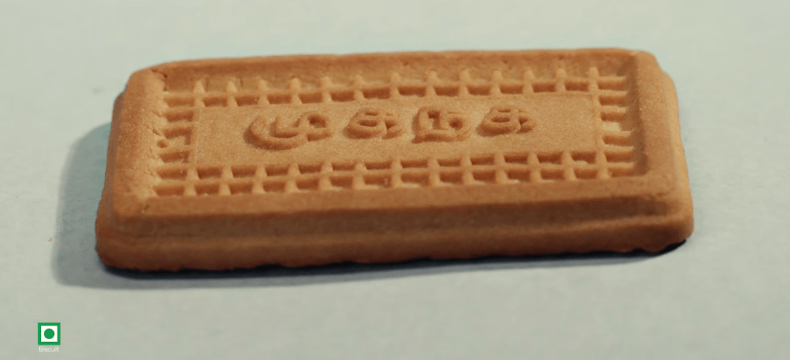
I was skeptical when I first came across Britannia Milk Bikis’ ThirukkuraL challenge back in the first week of June.
Now, after another new video has dropped (this one showing the remarkable process of manufacturing biscuits with Tamil words embossed on them) I’m even more skeptical.
Allow me to explain why.
First, a quick refresher for those outside Tamil Nadu.
More than 2,000 years ago, poet-philosopher ThiruvaLLuvar wrote the ThirukkuraL, a collection of 1,330 couplets that distill profound life lessons into just seven words spread across two lines. Incredibly concise, incredibly timeless.
If you studied in Tamil Nadu, you’ve almost certainly learnt at least a few of them in school. Some have become so popular over the decades that people quote them casually in conversations. Others have found renewed life through movies, literature and public discourse. Whether or not one remembers every KuraL today, the ThirukkuraL remains one of Tamil’s greatest cultural treasures.
Here’s a good resource for ThirukkuraL – in Tamil, English, with simple explanation.
Britannia’s idea is undeniably clever.
Instead of merely printing ThirukkuraLs on the wrapper, the company has actually embossed individual Tamil words directly onto Milk Bikis biscuits. The campaign asks consumers to discover these words, collect the remaining words by buying more packs, reconstruct the complete KuraL and upload it to a microsite to win prizes.
One important detail that I initially misunderstood (and I suspect many others might too) is that a single pack doesn’t contain all seven words required to form a KuraL. The words are scattered randomly across packs. Also, Britannia isn’t using all 1,330 KuraLs. The campaign revolves around just three carefully chosen KuraLs, whose individual words have been distributed across thousands of biscuits.
When I first heard about the campaign, I actually assumed each pack contained seven biscuits carrying one complete KuraL. That would have made immediate sense to me. A child or parent could assemble the verse at home, read its meaning printed inside the wrapper and perhaps even remember it.
But that isn’t the mechanic. And that’s where my skepticism begins.
The campaign’s starting insight, at least in the first film released in June, is that children are slowly becoming disconnected from the ThirukkuraL. The newer film broadens the idea further, showing adults admitting that they’ve forgotten KuraLs too.
In other words, Britannia begins with the premise that interest and familiarity have declined.
Yet everything that follows assumes exactly the opposite.
The campaign expects someone who is supposedly disengaged from the ThirukkuraL to notice a random word on a biscuit, think it’s interesting enough to preserve or photograph, buy more packs, figure out which of the three KuraLs that word belongs to, reconstruct the remaining six words and then upload the completed KuraL on a microsite.
That’s quite a lot to expect from an audience they’ve just described as having lost interest.
Successful collection mechanics usually work because at least one thing is already in your favour.
Either the intellectual property is already deeply loved, like Pokémon cards or the cricket stat cards we used to collect as kids.
Or the reward is immediate, like finding cash, coupons or under-the-cap prizes.
Or the collectible itself has standalone value.
Here, an isolated word like “kaRka” or “natpu” has almost no standalone meaning unless the person already knows the KuraL or is motivated enough to go looking for it.
That’s the contradiction I can’t quite reconcile. The campaign says people no longer care enough about the ThirukkuraL. But the mechanic assumes they’ll care enough to spend time, effort and repeated purchases trying to reconstruct one.
The friction doesn’t end there.
Curious to see how the experience worked, I opened the microsite.
On a desktop browser, I wasn’t greeted with the explanation itself. Instead, I was shown a QR code that had to be scanned using my phone. Fair enough.
But the mobile experience immediately asked for my name, my state (the campaign currently runs only in Tamil Nadu and Kerala) and my phone number. Entering the phone number triggered an OTP before I could proceed further.
Again, I found myself wondering whether this was asking a bit too much from the very audience the campaign itself describes as disengaged.
But interestingly, my biggest reservation isn’t even about motivation or digital friction.
It’s something much more fundamental. The campaign has fused the collectible with the consumable!
Think about the collectible campaigns many of us grew up with: Cricket cards, Gold Spot crowns, Big Fun bubblegum wrappers, etc.
What did they all have in common? The collectible survived after the product was consumed. You drank Gold Spot. The crown remained. You chewed Big Fun. The wrapper was saved.
The product disappeared. The collectible didn’t.
Milk Bikis turns that equation upside down. Here, the collectible is the biscuit itself. Eat it, and you’ve lost it. Keep it, and you’ve defeated the purpose of buying a biscuit.
Yes, you could photograph it before eating it. But then you’ve shifted the collectible from something physical to just another image sitting in your phone gallery.
Great collection mechanics also tend to become social experiences. Children compare collections. Friends exchange duplicates. People help each other complete sets. Entire conversations emerge because the collectible can move from one person to another.
What exactly gets exchanged here? A biscuit? A photograph of a biscuit? A screenshot?
The network effect that powers great collection campaigns feels largely absent because the collectible literally disappears once the product fulfills its purpose.
That’s why most FMCG collect-and-win campaigns separate the collectible from the consumable. The wrapper. The cap. A coupon. A printed code. Basically, something survives/can be preserved/exchanged.
Ironically, if the objective was to rekindle interest in the ThirukkuraL itself, there may have been simpler and perhaps even more effective behavioral designs.
Imagine every wrapper carrying one complete KuraL, with different KuraLs appearing across the range.
Or one line printed on one wrapper and the second line on another, encouraging people to pair and exchange wrappers.
Or QR codes that unlock simple stories explaining the meaning of each KuraL.
Or wrappers themselves becoming collectible cards that children can keep, trade and discuss.
Those mechanics reward collection, and reward engagement with the literature itself.
None of this should take away from what the campaign gets spectacularly right.
Printing Tamil words directly onto biscuits is a remarkable manufacturing achievement. The visual itself is instantly memorable. It’s culturally rooted, beautifully executed and almost guaranteed to generate PR.
Watching the second film, I couldn’t help but admire the engineering that made it possible.
But I also couldn’t shake off another thought. I wonder whether the client and agency became just a little too enamored by the sheer brilliance of that manufacturing innovation (the ability to emboss Tamil words on biscuits) that the behavioural mechanics received comparatively less scrutiny.
Because that’s where I think the campaign falls short. As manufacturing innovation, it’s remarkable. As PR, it’s memorable. As cultural symbolism, it’s beautiful.
But as behavioral design, I think it asks too much from the very audience it begins by describing as disengaged.
And that’s why, despite admiring the ingenuity behind it, I remain skeptical.