
If you have followed food safety news in India recently, your kitchen probably feels like a biohazard zone. And I’m not even talking about Tukaram Mundhe!
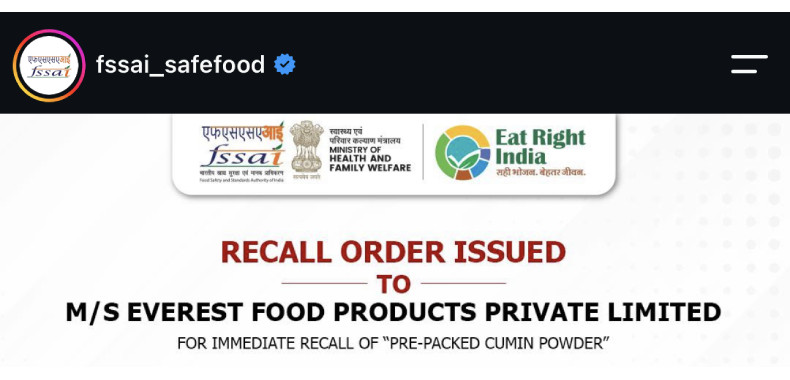
Every few weeks, a news notification pops up declaring that a staple spice, a dairy item, or a popular packaged food has been flagged or recalled by the Food Safety and Standards Authority of India (FSSAI). The latest instance involves a recall notice issued for Everest Cumin Powder (Batch No. E080668761) due to pesticide residue levels exceeding Maximum Residue Limits and this followed a familiar playbook.
Within hours, mainstream media outlets published sweeping headlines like this!
No, not just online, but in print too! Consider this Economic Times headline and report!

To an average consumer reading these headlines while chopping vegetables, the takeaway is binary and alarming: Everest cumin powder is poison. Throw it away. Don’t buy it again.
But that isn’t what the regulatory order actually said.
FSSAI’s enforcement action was strictly batch-specific. It applied to one specific manufacturing run. The hundreds of thousands of other packets sitting on supermarket shelves and inside our home pantries/kitchens were/are unaffected.
This is not an isolated incident. Take this tweet, for instance, which talks about action taken on Nestle’s low fat dairy whitener.
From this “notice”, can you, as a normal consumer user understand what you should do if,
(a) you had it in your home/kitchen with the pack intact?
(b) you had transferred the content to an air-tight container and did not have the pack with you anymore?
(c) you are planning to buy it shortly?
The answer to all 3 – nope.
Take this other example, of action against Wai Wai noodles’ parent brand, CG Foods:
Questions a and b are completely unclear, while c is slightly clearer, since the notice states that CG Foods was directed to discontinue production of the unapproved Veg Bhujia Namkeen products. However, it does not state whether existing stock already shipped to retail markets across the country is being recalled or pulled from store shelves. While you know to be cautious or avoid buying these specific variants, you cannot tell if what is currently on supermarket shelves is affected or safe stock from another manufacturing facility.
This gap, between what FSSAI intends to communicate and what the public actually understands, highlights a fundamental flaw in how the regulator operates. FSSAI is doing the hard, essential work of testing, sampling, and policing food safety. But its public communication framework is sadly broken.
By treating public advisories like legal notices rather than consumer risk communication, FSSAI is accidentally fueling market panic, unfairly damaging brand equities, and ultimately creating alert fatigue among the very people it is trying to protect.
To be clear, this is not an argument for going easy on non-compliant brands… strict enforcement is non-negotiable. This is about ensuring that FSSAI’s actions inform citizens rather than simply terrifying them.
The anatomy of FSSAI’s communication failure
When analyzing FSSAI’s public outputs, whether on X, Instagram, or press releases, 3 structural communications problems emerge:
1. B2B regulatory language dropped into a B2C world
FSSAI’s notices are written for compliance lawyers, factory managers, and state food safety officers. They cite legal sections, chemical names (azoxystrobin, thiamethoxam), and 11-digit alphanumeric batch numbers.
When you drop dense B2B compliance speak into the public domain, mainstream media acts as the translator. And media incentives favor drama over nuance. A headline that says, “Batch E080668761 of Everest Cumin Exceeds Pesticide MRLs” gets zero clicks. But “FSSAI Bans Everest Cumin Powder” goes viral. FSSAI routinely abdicates the responsibility of translating technical data into consumer-friendly context, letting headline-writers dictate public perception.
2. The unrealistic expectation of “batch checking”
The official defense for batch-level alerts is that consumers simply need to check the package. But expecting an everyday shopper, standing in a crowded kirana store or ordering on a quick-commerce app in 10 minutes, to cross-reference a faint, tiny ink stamp on the back of a foil pouch against a tweet by a government handle is completely detached from normal human/consumer behavior.
When checking the fine print is too tedious, people default to a simple risk-aversion response: they stop buying the brand entirely.
3. Amplified problems, silent resolutions
This is perhaps the most damaging flaw in the current lifecycle of a food recall:
Step 1: Public recall order shared via FSSAI’s social handles
Step 2: Viral media panic using famous brand names in headline
Step 3: Factory rectification
Step 4: Silent case closure
FSSAI announces the problem with a bullhorn. But once the manufacturer pulls the bad batch, destroys non-compliant stock, and passes re-testing, the matter is closed quietly inside regulatory filing systems like FoSCoS.
https://foscos.fssai.gov.in/food-recall
Closure announcements are far less visible: “The recall for product X is now complete. New batches on the market have been verified and are safe to purchase”.
Because the regulator never closes the loop publicly, the consumer is left suspended in permanent uncertainty. Is the brand safe now? Did they fix it? Has it been two weeks or two years?
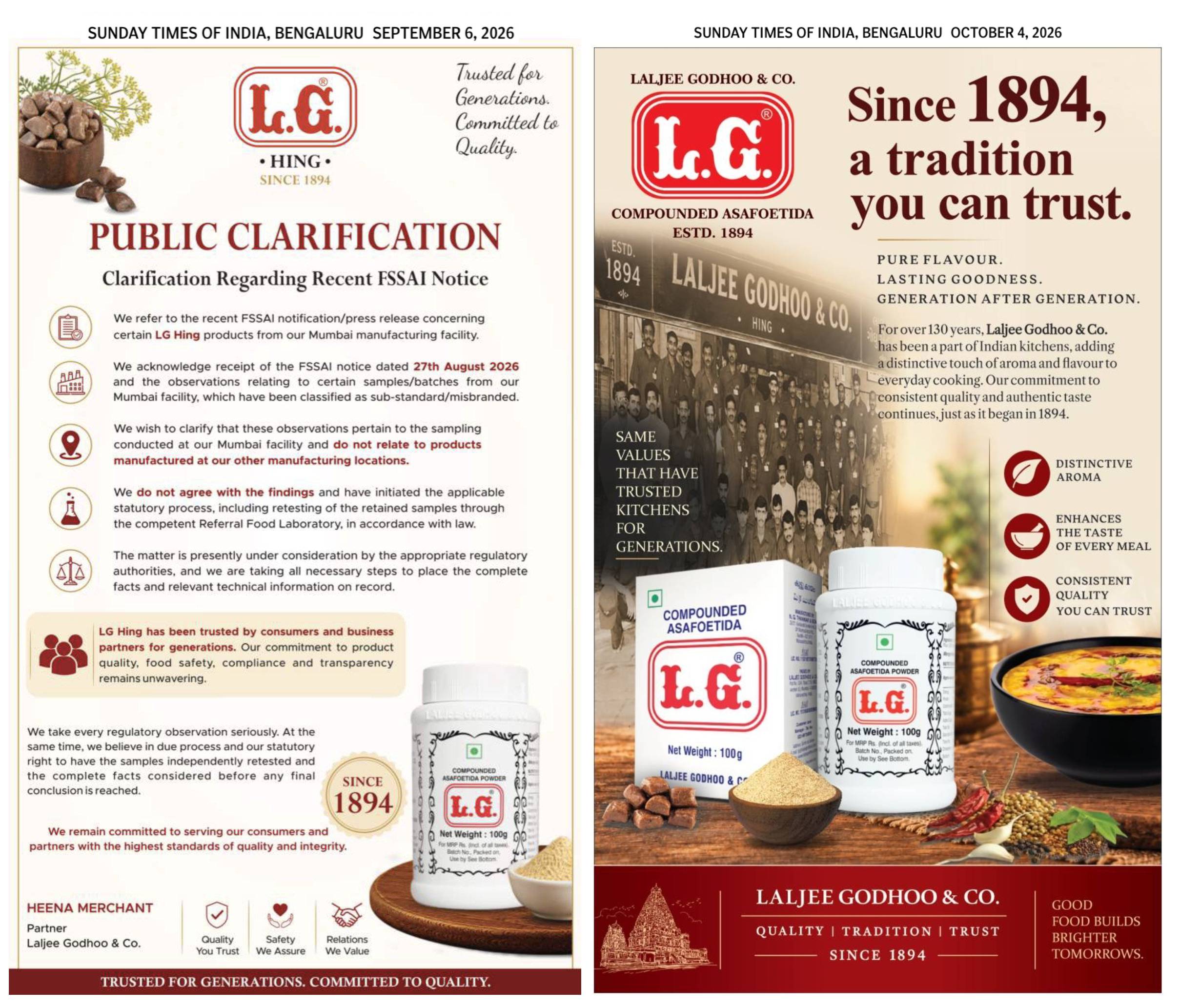
Or, we need to wait for the brands to advertise again and then wonder, ‘Is that FSSAI action over?’. This happened recently with LG Hing!
FSSAI note on August 29th:
Here are the 2 ads by LG. The first one addresses the points raised by FSSAI but the 2nd, recent one offers no link to the earlier ad and seems like a normal brand ad without any prior context to the prohibition order!
The danger is ‘alert fatigue’. When every regulatory advisory feels like a catastrophic brand ban, one of two things happens:
a. Unnecessary panic: Consumers needlessly discard perfectly safe food and avoid brands indefinitely.
b. Total apathy: Over time, continuous low-context warnings lead to cynicism. People start believing “everything in India is contaminated anyway” and stop paying attention to safety advisories altogether.
When a public safety authority causes its audience to tune out, its regulatory power diminishes.
How FSSAI can fix its risk communication strategy
Fixing this doesn’t require stopping enforcement. It requires modernizing how safety data is published. A modern food safety regulator must consider adopting a consumer-first risk communication model.
1. Put the consumer action in the headline
Every FSSAI advisory should answer five questions immediately:
WHAT? Product and variant
WHICH BATCH? Batch/lot number, manufacture date and other identifying details
WHY? Plain-English explanation of the violation or hazard
WHAT SHOULD I DO? Discard, return, stop consuming, or no action required
WHAT ABOUT OTHER BATCHES? Clearly state whether they are covered or not
The Everest advisory could therefore have said:
DO NOT CONSUME: Everest Cumin Powder, Batch E080668761. Pesticide residues exceeded prescribed limits. Other batches are not covered by this recall.
This is still alarming. But it is at least usefully alarming!
Most importantly, every communication from FSSAI should include a link or a bar code where people can get more information. So, for instance, if FSSAI is alerting us about LG Hing, a direct link to know more about what I as a consumer of the brand should do next is essential. I should also be able to see what the company’s response was/is, if there is a date for the next update and if I can subscribe for such an update through any method (phone number, email, etc.).
2. Adopt standardized hazard ratings
FSSAI doesn’t necessarily need to invent a new risk-communication system. It could look at how the FDA communicates recall severity and status. It classifies recalls as Class I, II or III according to the potential health hazard, ranging from a reasonable probability of serious harm or death to situations where adverse health consequences are unlikely.
FSSAI could consider a similar system, adapted to Indian food-safety regulations and determined by its scientific experts. The important thing is not the color coding or the terminology. It is about giving consumers context.
Is this an immediate health risk? Is the concern primarily about a specific batch? Is it a technical or labeling violation? What exactly should I do? Today, a consumer can encounter the words ‘unsafe’, ‘substandard’, ‘misbranded’ and ‘recall’ without necessarily understanding how they differ in practical risk. A standardized risk classification would give both consumers and the media a common language.
3. Build a searchable “Live Recall Portal”
Instead of letting advisories vanish into a social media feed, FSSAI needs a clean, public-facing web database. The current listing on FoSCoS literally looks like an Excel sheet ported to a web page!
A consumer or journalist should be able to type in “Everest Cumin” or scan a package barcode (through an FSSAI app) and immediately see:
Active recalls: Batch E080668761 (Active)
Cleared batches: All batches manufactured after [Date]
Status: Case resolved/Verified safe on [Date]
4. Shift verification from the shopper to the supply chain
Relying on human vigilance at checkout is actually a design failure. FSSAI should coordinate with retail POS systems and quick-commerce platforms (Blinkit, Instamart, Zepto, Bigbasket, etc.), all of whom have a need to know and record batch numbers, to link recall orders directly to product barcodes. If a customer attempts to buy a recalled batch, the barcode should automatically trigger a block at the billing register or in the dark-store picking app. Safety should be made system-dependent, not manual.
5. Close the communication loop
Communication requires resolution. When a manufacturer complies, cleans up its supply chain, and passes re-testing, FSSAI must publish a standardized “Recall terminated/Product cleared” notice. Restoring brand trust when compliance is met is just as important as flagging non-compliance in the first place.
The crux
FSSAI’s job is not just to catch non-compliant food. It is to maintain a safe, reliable, and transparent food ecosystem.
When regulatory communication creates chaos instead of clarity, it fails the very citizens it aims to protect. It is time for FSSAI to realize that how you say something is just as important as what you find. Until they shift from issuing legal declarations to executing clear consumer risk communications, every food safety win will continue to feel like a public relations failure.